

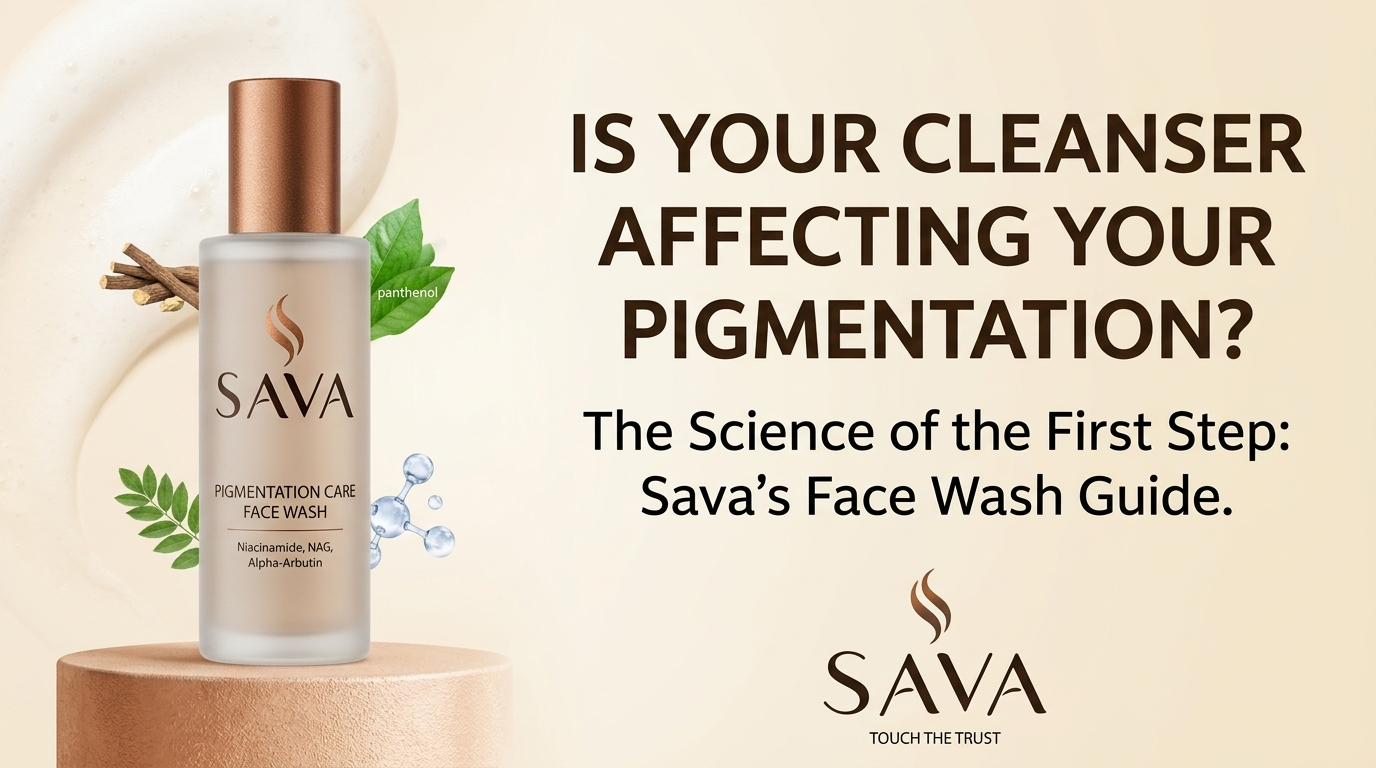
The science of cleansing, pigmentation and why a healthy skin barrier starts with the very first step.
We spend a surprising amount of money on serums, moisturisers and sunscreens.
But here’s a question: what about the product we use first?
Your face wash.
It’s probably the most underestimated product in your skincare routine. We apply it, massage for a few seconds, rinse it off and move on.
But cleansing is not just about removing dirt. The way you cleanse can influence how comfortable your skin feels, how well it retains moisture and how effectively the rest of your routine fits together.
And if pigmentation is your concern, getting this first step right matters.
1. Your skin is not a dirty plate. Stop treating it like one!
Let’s get something straight.
Your skin needs cleansing, not punishment.
Throughout the day, your face collects sweat, excess sebum, environmental particles, sunscreen and makeup residue.
A good cleanser helps remove these unwanted substances without unnecessarily stripping the skin.
But aggressive cleansing can create another problem.
When your cleanser is too harsh, or you scrub excessively, your skin may become dry, tight, irritated and uncomfortable.
And here’s the interesting connection: irritation and inflammation can contribute to post-inflammatory hyperpigmentation, particularly in skin that is prone to dark marks.
So, if your face feels squeaky-clean but immediately starts feeling tight, that isn’t necessarily a sign of excellent cleansing.
Sometimes, it’s a sign that you need a gentler approach.
2. Can your face wash actually help with pigmentation?
Yes, but let’s understand the difference between supporting pigmentation care and treating pigmentation.
Pigmentation occurs when melanin production or distribution becomes uneven.
Common triggers include:
* UV exposure.
* Inflammation following acne.
* Skin irritation.
* Hormonal influences.
* Certain skin conditions.
A pigmentation-focused cleanser can introduce useful skin-conditioning and brightening-support ingredients into your routine.
However, there’s one important detail.
A face wash is a rinse-off product. Unlike a serum or moisturiser, it stays on your skin for a relatively short period.
This means ingredient concentration, formulation, stability, delivery and contact time all matter.
A cleanser containing pigmentation-care ingredients should not automatically be expected to produce the same results as a leave-on treatment containing those ingredients.
Think of it as the foundation of your routine, not the entire building.
3. Let’s meet the ingredients that make cleansing more interesting.
Our selected Sava Pigmentation Care Face Wash formulation direction brings together six ingredients, each with a different purpose.
Niacinamide – More than just a brightening ingredient
Niacinamide, also known as Vitamin B3, is one of the most researched cosmetic skincare ingredients.
It supports the skin barrier and has been studied for its role in improving the appearance of uneven pigmentation.
Research suggests it can influence the transfer of melanosomes from pigment-producing cells to surrounding skin cells.
In simpler language, it can help improve the appearance of uneven skin tone.
But its job doesn’t stop there. It also supports overall skin conditioning.
N-Acetyl Glucosamine – The underrated team player
Meet NAG.
N-Acetyl Glucosamine is an ingredient with an interesting history in pigmentation research.
It has been investigated for its potential to improve the appearance of uneven skin tone.
What’s particularly interesting is its combination with Niacinamide.
Research on leave-on moisturising formulations containing both ingredients has demonstrated improvements in the appearance of facial pigmentation.
However, those findings should not be directly transferred to a rinse-off face wash. The exposure conditions are different.
Licorice Extract – A botanical with a scientific side
Licorice is more than a traditional herbal ingredient.
Certain compounds derived from licorice, including glabridin, have been investigated for their antioxidant, soothing and pigmentation-related properties.
It gives the formulation a botanical component while supporting its skin-conditioning direction.
The actual benefits depend on the extract type, standardisation and concentration used.
Panthenol – The comfort ingredient
Ever used a cleanser that leaves your face feeling uncomfortable?
Panthenol, also known as Provitamin B5, is a useful skin-conditioning ingredient.
It is valued for its moisturising and soothing properties.
In a cleansing formulation, it helps support the objective of a comfortable post-wash skin feel.
Alpha-Arbutin – A recognised pigmentation-care active
Alpha-Arbutin is widely used in products targeting the appearance of uneven pigmentation.
It works by inhibiting tyrosinase, an enzyme involved in melanin production.
It is an interesting addition to a pigmentation-focused formulation.
However, its inclusion does not mean a rinse-off cleanser will deliver the same performance as a properly formulated leave-on product.
Its concentration, stability and finished-product safety must be assessed by the manufacturer.
Hyaluronic Acid – Because cleansing shouldn’t mean forgetting hydration
Hyaluronic Acid is a humectant that attracts and holds water.
It is widely used in skincare to support hydration and improve the appearance of skin suppleness.
In a face wash, the formulation should aim to cleanse effectively while helping maintain a comfortable skin feel.
4. The real secret is not just what you wash with. It’s how you wash.
Even a thoughtfully formulated cleanser cannot compensate for poor cleansing habits.
Here’s a simple dermatologist-friendly approach:
1. Wet your face with lukewarm water.
2. Take an appropriate amount of cleanser.
3. Gently massage using your fingertips.
4. Avoid aggressive rubbing and unnecessary scrubbing.
5. Rinse thoroughly.
6. Pat your face dry with a soft towel.
7. Follow with moisturiser.
For most people, cleansing twice daily and after heavy sweating is sufficient. If your skin is particularly dry or sensitive, adjust the frequency to what your skin tolerates.
And please, don’t use extremely hot water thinking it will open your pores. Your skin doesn’t need a sauna session every morning!
5. Indian skin, Indian weather: why cleansing needs a little more thought.
Between summer heat, humidity, dust, pollution, sunscreen and changing seasons, our skin experiences different environmental conditions throughout the year.
Someone living in a humid city may prefer a different cleansing experience from someone dealing with dry winter weather.
But here’s what remains important across climates:
* Don’t over-cleanse.
* Don’t chase excessive foam.
* Don’t scrub pigmentation away.
* Don’t ignore hydration after cleansing.
* Don’t skip sunscreen during the day.
Your skincare routine should adapt to your skin’s needs, not simply follow whatever is trending online.
6. A face wash cannot do the entire job. Build a routine.
If your goal is to care for uneven skin tone, think of your routine as a team.
Morning
1. Pigmentation Care Face Wash.
2. Evenflow Face Serum.
3. Pigmentation Care Moisturiser.
4. Broad-spectrum sunscreen.
Night
1. Pigmentation Care Face Wash.
2. Evenflow Face Serum, if tolerated and appropriate for your routine.
3. Pigmentation Care Moisturiser.
Introduce new products gradually, particularly if you have sensitive skin.
If you experience persistent irritation, burning or worsening pigmentation, consult a dermatologist.
7. What Sava believes about cleansing.
At Sava, we don’t believe that skincare should begin and end with a product claim.
We believe people should understand what they are applying to their skin and why.
Our Pigmentation Care Face Wash is being developed around a combination of cleansing, skin conditioning, hydration and pigmentation-care ingredients.
Niacinamide, N-Acetyl Glucosamine, Licorice, Panthenol, Alpha-Arbutin and Hyaluronic Acid form the selected ingredient direction.
The intention is simple: make the first step of your skincare routine more thoughtful.
Because your face wash should prepare your skin for the rest of your routine, not leave it feeling like it needs rescuing.
Cleanse gently. Care consistently. Protect daily.
Sava Skincare – Touch the Trust.
⸻
Disclaimer: This article is for general skincare education and is not a substitute for medical advice. Individual results vary. A rinse-off cleanser should not be considered a standalone treatment for melasma or other medical pigmentation conditions. Persistent or unexplained pigmentation should be evaluated by a qualified dermatologist.
← Back to Blog


